
• Skip to primary navigation
  • Skip to main content
  • Skip to footer
Deibel Laboratories

Deibel Laboratories

Science you can trust from concept to consumer.

  • ABOUT US
    • MEET OUR STAFF
    • ACCREDITATION
    • TERMS AND CONDITIONS
  • SERVICES
    • TESTING SERVICES
      • MICROBIOLOGY
      • CHEMISTRY
      • BACTERIAL / FUNGAL IDENTIFICATION
      • ALLERGEN TESTING
      • NUTRIENT ANALYSES FOR LABELING AND CLAIMS
      • TOXIN TESTING
      • FDA DETENTION SAMPLING
      • PERSONAL CARE & COSMETICS
    • SPECIAL PROJECTS
      • CHALLENGE STUDIES
      • SHELF LIFE STUDIES
      • PROCESS VALIDATION
      • METHOD/MATRIX VALIDATION
    • ADVISORY SERVICES
    • ENVIRONMENTAL MONITORING SERVICES
    • BIOFUELS
    • DEIBEL COLAB 2.0
  • TRAINING AND EDUCATION
    • HACCP TRAINING
    • FSPCA PCQI TRAINING
    • SANITATION OPERATOR TRAINING
    • MICROBIOLOGY 101
    • FSPCA FOREIGN SUPPLIER VERIFICATION PROGRAM (FSVP) TRAINING FOR IMPORTERS OF FOODS FOR HUMAN AND ANIMALS
    • LABELING REQUIREMENTS FOR FOODS AND BEVERAGES
      MARKETED IN THE U.S.
    • GOOD MANUFACTURING PRACTICES
  • CONTACT US
  • Show Search
Hide Search

food industry

FDA Releases Findings on RTE Dips and Spreads

Ryan Maus · July 14, 2023 ·

In 2021, the U.S. Food and Drug Administration (FDA) conducted a routine assignment to collect domestic multi-commodity ready-to-eat (RTE) refrigerated dips and spreads to test for Listeria monocytogenes and Salmonella spp. The agency’s goal in conducting this assignment was to determine the prevalence of these pathogens in RTE dips and spreads and remove adulterated products from the market, when possible.

The assignment, which ran from March 2021 to January 2022, found that four out of the 747 samples tested were contaminated with Salmonella or L. monocytogenes. Ready-to-eat foods can become contaminated with environmental pathogens from harborage sites in the food manufacturing environment or process. Cross-contamination from ingredients can also occur.   Additionally, dips and spreads often have a pH and water activity that favor bacterial survival and outgrowth.  Consumers typically eat these dips and spreads without a ‘kill step,’ such as cooking, to reduce or eliminate any pathogenic bacteria that may be present. As such, dips and spreads contaminated with L. monocytogenes or Salmonella can present a significant public health risk. Ready-to-eat dips such as hummus and cheese spreads have been associated with multiple recalls over the past few years. The FDA’s assignment was initiated due to five recalls of hummus products and six recalls of multi-commodity dips found to be contaminated with L. monocytogenes or Salmonella from FY2017 through FY2020.

During the sampling assignment, the FDA identified Salmonella Havana in a sample of hummus from a retail establishment in California.  The FDA notified the manufacturer of the hummus and a recall was initiated.  The FDA conducted a follow-up inspection at the manufacturer of the contaminated product to evaluate the firm’s manufacturing operations and collect environmental samples. The FDA found that the firm did not establish and implement adequate written procedures for monitoring sanitation control procedures (i.e., cleanliness of food-contact surfaces). The environmental samples collected at the follow-up inspection did not yield any positive pathogens, however, the agency still issued a warning letter after the follow-up inspection.  After taking corrective actions, the firm was unable to identify a root cause for the Salmonella Havana contamination in the hummus.

The FDA identified L. monocytogenes in three samples from a retail establishment in Colorado and the agency notified the firm where the positive samples were manufactured. All three of the samples contaminated with L. monocytogenes were produced by the same manufacturer. Upon notification of the contaminated samples, the firm recalled and destroyed the products associated with the positive findings. The agency issued a Consumer Advisory in conjunction with the firm’s recall.

The agency conducted a follow-up inspection at the manufacturer of the three contaminated products. The follow-up inspection sought to evaluate the firm’s manufacturing operations and collect environmental samples to determine potential sources and routes of contamination. The FDA found L. monocytogenes in 23 swabs collected within the production environment, including samples collected from food contact surfaces. WGS analysis was conducted on the L. monocytogenes isolates obtained from both the retail product samples and the inspection environmental samples. The isolates were a genomic match to each other.

The FDA’s follow-up inspection determined the firm’s employees were not trained in food safety or hygiene practices and found multiple instances of deficient sanitation practices related to equipment, utensils, and employees. The agency determined that the firm did not respond appropriately to the positive samples identified in the sampling assignment and had not addressed objectionable conditions observed by the FDA during a previous 2020 inspection.  The firm went out of business at the end of June 2021.

Underscored in the FDA’s report is the necessity for manufacturing firms to have good manufacturing practices in place, as well as a proper environmental monitoring program and adequate training for its staff as part of their standard business operating procedures.

Deibel Laboratories has years of experience in conducting shelf-life studies, formulation reviews, and validations for refrigerated dips and spreads.  Our staff of industry experts is ready to assist you in assuring that your manufacturing processes and facilities comply with the stringent food safety standards required by the FDA and USDA.  With a complete suite of accredited pathogen testing methods and the testing capacity of 15 laboratories strategically placed throughout North America, Deibel Laboratories is your one-stop for assuring food safety compliance.

Contact us at Sales@DeibelLabs.com for more information about a laboratory near you. Visit us at https://deibellabs.com/services/deibel-guardianemp/ to learn more about our environmental monitoring program, Deibel GuardianEMPsm. Link to FDA findings: FY21-22 Sample Collection and Analysis of Domestic Refrigerated RTE Dips and Spreads | FDA
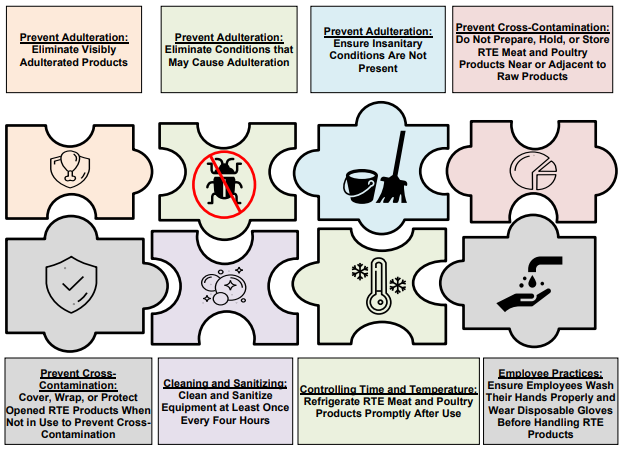
The Eight Most Important Recommendations for Controlling Listeria monocytogenes in Retail Delicatessens

Laurie Post · July 6, 2023 ·

The USDA Food Safety and Inspection Service (FSIS) recently published a guidance document that provides recommendations that retailers can use in delicatessens to control L. monocytogenes contamination of ready-to-eat (RTE) meat and poultry products. This 2023 document is a revised version of the 2015 FSIS Best Practices Guidance for Controlling Listeria monocytogenes (Lm) in Retail Delicatessens. It reflects the FSIS’s current thinking on this topic and is not a regulation. While focused on small firms, the recommendations made will be useful for all meat and poultry retail firms.


Recommendations are based on the joint FSIS, Food and Drug Administration (FDA), and Centers for Disease Control and Prevention (CDC) 2013 Listeria monocytogenes in Retail Delicatessens Interagency Risk Assessment. The assessment summarizes the risks posed by L. monocytogenes from the consumption of RTE foods commonly prepared and sold in retail delis.

The guidance addresses:

  • Actions retailers can take in the delicatessen (deli) area to decrease the potential for
    L. monocytogenes growth and cross-contamination.
  • Steps retailers can take to help ensure that deli products are maintained under sanitary conditions
    that do not allow L. monocytogenes adulteration of the product.
  • Information from the U.S. Food and Drug Administration’s (FDA) Food Code, scientific literature,
    other guidance documents, and lessons learned from meat and poultry establishments that
    retailers can use to control L. monocytogenes.
  • Helpful tools that retail firms can use to identify potential gaps in current best practice procedures.
  • The eight most important recommendations for retail deli operations.

Retailers can use the best practices identified in this guidance to help ensure that RTE meat and poultry products in the deli area are handled under sanitary conditions and are not adulterated, as defined in the Federal Meat Inspection Act (FMIA) and Poultry Products Inspection Act (PPIA).

While these practices are designed to control L. monocytogenes specifically, they also may help control other foodborne pathogens that may be introduced into the retail deli environment and other facilities where consumers take possession of food. No single action or practice will control L. monocytogenes contamination. Therefore, by following the best practices in this guidance and the Food Code, retailers can help ensure that RTE products are not adulterated with L. monocytogenes, and that the potential for listeriosis is decreased.

A Deli Self-Assessment Tool is provided for deli operators in Appendix A of this guidance to help them identify the best practices they are using and to assess whether they need to adopt others.

A Comprehensive Approach: The Eight Most Important Retail Deli Recommendations to Prevent
Conditions That May Cause Adulteration (Source: USDA FSIS

Hepatitis A Outbreak Associated Frozen Strawberries

Ryan Maus · May 23, 2023 ·

By Ryan Maus

A new outbreak of hepatitis A virus has been associated with frozen organic strawberries and sickened five people (with two hospitalizations) from the state of Washington. The strawberries were distributed to numerous retail locations across the country, sometimes comingled with other fruit products. This has led to numerous recalls of products with best by dates as far away as November 2024. The ongoing outbreak serves as a reminder of the hazard viruses can present for certain ingredients and the subsequent products (such as smoothies and juice) in which they are often used.

Outbreaks of hepatitis A are generally reported after epidemiological evidence points to a common food or water source. The virus replicates inside human host cells and is shed in human feces. The virus does not multiply in or on foods but can be transmitted by food and water contaminated with human fecal material. Several fecal-oral scenarios leading to an outbreak include contaminated irrigation or wash water, sick field workers during harvest, or ready-to eat products contaminated by sick food handlers. The current outbreak strain of hepatitis A virus is genetically identical to the hepatitis A strain found in fresh organic strawberries that caused an outbreak in 2022. Organic strawberries in both outbreaks were sourced from farms located in Baja California, Mexico.

Hepatitis A Foodborne Outbreaks (Source FDA and CDC)

YearProductVirusIllness
2023
2022
2019
2017
2016
2016
2013
Frozen Strawberries
Frozen Strawberries
Fresh Blackberries
Frozen Tuna
Frozen Strawberries
Raw Scallops
Pomegranate Seeds
Hepatitis A
Hepatitis A
Hepatitis A
Hepatitis A
Hepatitis A
Hepatitis A
Hepatitis A
5 (currently)
18
20
Unknown
143
292
162

Berries contaminated with hepatitis A can also pose a hazard when processed into products such as fresh fruit smoothies or juice. A recent warning letter was issued to a juice manufacturer that used contaminated strawberries in the formulation of a high pressure processed (HPP) juice product. The manufacturer did not validate that the HPP treatment would produce the required minimum 5-log reduction to control the target pathogen (hepatitis A virus). Generally, cooking food until it’s at a
temperature of 190˚F in the middle for at least 1½ minutes or boiling food in water for at least 3 minutes inactivates the virus. However, if present, the virus is very hardy and can survive on food, in water, and on environmental surfaces for extended periods of time. Hepatitis A illness usually begins about 2-4 weeks after exposure causing symptoms of fever, low appetite, nausea, vomiting, diarrhea, muscle aches, and jaundice. The virus can clear on its own within a week or two.

However, in some instances, the infection can last up to 6 months and cause inflammation and damage to the liver. Although the virus cannot grow in the
environment, it is considered to be extremely stable under a wide range of environmental conditions, including freezing, heat, desiccation, and chemicals. Concentrations of disinfectants commonly used against pathogenic bacteria might not be effective. A vaccine for the virus has provided a reasonable control measure to prevent the spread of hepatitis A. Preventive measures generally include good food handler hygiene, supplier verification programs, use of potable water, thermal processing, and proper sanitation.

MICROBIOLOGY “101”: FUNDAMENTALS OF MICROBIOLOGY FOR FOOD INDUSTRY PROFESSIONALS

Antonio Alcaraz · April 24, 2023 ·

Virtual Educational Course

November 15, 2023 All day

Understanding the microorganisms that threaten Food Safety and cause food spoilage is fundamental to manufacturing safe and wholesome food products. Microorganisms are everywhere but how can they be controlled in a food production facility?
This course will cover the basics of food safety microbiology and arm you with the information you need to avoid microbial contamination and produce safe food products.
The course features an innovative format, with interactive discussions as well as “virtual lab” demonstrations of microbial detection methods.

Course Topics Include:

• Microbial Ecology: Food safety depends on knowing the conditions that encourage microbial growth and knowing how to keep pathogens out, kill them or keep them from growing.
• Food-borne Pathogens: An understanding of Salmonella, Listeria monocytogenes, Shiga toxin-producing E. coli (STEC) and other pathogens of concern can lead to better strategies for control.
• Indicator organisms: These nonpathogenic organisms are valuable verification tools for hygiene and process controls.
• Spoilage: Yeast and mold are major players in food spoilage. Knowing how to detect, identify and control them can extend shelf life.
• Sampling and Testing: Statistically representative sampling plans and standard methods of analysis are critical to obtaining credible data by which food safety decisions can be made.
• Current Food Safety Issues: Staying informed about foodborne illness outbreaks, recalls and regulations is essential to managing your Food Safety Plan.

Microbiology 101 Team

Book Now

For more information on Microbiology “101” training offered by Deibel Laboratories, please contact Sales at Sales@DeibelLabs.com (847-329-9900).

  • Google Calendar
  • iCalendar
  • Outlook 365
  • Outlook Live

MICROBIOLOGY “101”: FUNDAMENTALS OF MICROBIOLOGY FOR FOOD INDUSTRY PROFESSIONALS

Antonio Alcaraz · April 24, 2023 ·

Virtual Educational Course

September 7, 2023 All day

Understanding the microorganisms that threaten Food Safety and cause food spoilage is fundamental to manufacturing safe and wholesome food products. Microorganisms are everywhere but how can they be controlled in a food production facility?
This course will cover the basics of food safety microbiology and arm you with the information you need to avoid microbial contamination and produce safe food products.
The course features an innovative format, with interactive discussions as well as “virtual lab” demonstrations of microbial detection methods.

Course Topics Include:

• Microbial Ecology: Food safety depends on knowing the conditions that encourage microbial growth and knowing how to keep pathogens out, kill them or keep them from growing.
• Food-borne Pathogens: An understanding of Salmonella, Listeria monocytogenes, Shiga toxin-producing E. coli (STEC) and other pathogens of concern can lead to better strategies for control.
• Indicator organisms: These nonpathogenic organisms are valuable verification tools for hygiene and process controls.
• Spoilage: Yeast and mold are major players in food spoilage. Knowing how to detect, identify and control them can extend shelf life.
• Sampling and Testing: Statistically representative sampling plans and standard methods of analysis are critical to obtaining credible data by which food safety decisions can be made.
• Current Food Safety Issues: Staying informed about foodborne illness outbreaks, recalls and regulations is essential to managing your Food Safety Plan.

Microbiology 101 Team

Book Now

For more information on Microbiology “101” training offered by Deibel Laboratories, please contact Sales at Sales@DeibelLabs.com (847-329-9900).

  • Google Calendar
  • iCalendar
  • Outlook 365
  • Outlook Live

  • « Go to Previous Page
  • Page 1
  • Interim pages omitted …
  • Page 4
  • Page 5
  • Page 6

Footer

CONTACT US

Have a question? Contact our Sales team.

Request Info

Subscribe to our newsletter

Subscribe

“Science you can trust from concept to consumer -since 1967”

We are proud of our integral role in helping to ensure product safety and quality for all our clients.

  • Facebook
  • LinkedIn
  • Twitter

CAREERS

Deibel Laboratories is always seeking energetic individuals to fill positions at our rapidly growing corporation of food and pharma/cosmetic testing laboratories.

VIEW CAREERS

LOCATIONS

California, Idaho, Pennsylvania, Sarasota, Gainesville, Lakeland, Illinois, Minnesota, Missouri, Wisconsin, Kansas, Tennessee, Texas, Canada

SEE LOCATIONS

Copyright © 2026 Deibel Laboratories, All Rights Reserved.
PRIVACY NOTICE · COOKIE POLICY · TERMS AND CONDITIONS