
• Skip to primary navigation
  • Skip to main content
  • Skip to footer
Deibel Laboratories

Deibel Laboratories

Science you can trust from concept to consumer.

  • ABOUT US
    • MEET OUR STAFF
    • ACCREDITATION
    • TERMS AND CONDITIONS
  • SERVICES
    • TESTING SERVICES
      • MICROBIOLOGY
      • CHEMISTRY
      • BACTERIAL / FUNGAL IDENTIFICATION
      • ALLERGEN TESTING
      • NUTRIENT ANALYSES FOR LABELING AND CLAIMS
      • TOXIN TESTING
      • FDA DETENTION SAMPLING
      • PERSONAL CARE & COSMETICS
    • SPECIAL PROJECTS
      • CHALLENGE STUDIES
      • SHELF LIFE STUDIES
      • PROCESS VALIDATION
      • METHOD/MATRIX VALIDATION
    • ADVISORY SERVICES
    • ENVIRONMENTAL MONITORING SERVICES
    • BIOFUELS
    • DEIBEL COLAB 2.0
  • TRAINING AND EDUCATION
    • HACCP TRAINING
    • FSPCA PCQI TRAINING
    • SANITATION OPERATOR TRAINING
    • MICROBIOLOGY 101
    • FSPCA FOREIGN SUPPLIER VERIFICATION PROGRAM (FSVP) TRAINING FOR IMPORTERS OF FOODS FOR HUMAN AND ANIMALS
    • LABELING REQUIREMENTS FOR FOODS AND BEVERAGES
      MARKETED IN THE U.S.
    • GOOD MANUFACTURING PRACTICES
  • CONTACT US
  • Show Search
Hide Search

microbiology

Know Your Suppliers to Protect Your Products

Laurie Post · December 1, 2023 ·

A Supply-Chain Control Program assures that the ingredients, raw materials, and non-food chemicals you receive are safe and suitable for use. Supplier control is an essential element of a preventive food safety system. The program is built on ingredient specifications that are defined following a hazard analysis, criteria for supplier selection, a process for approving suppliers, development of supplier agreements, and verification activities to assure that the program is in place and effective.

The hazard analysis identifies biological, chemical, physical, and Economically Motivated hazards associated with an ingredient that requires a control to significantly minimize or eliminate the hazard at your facility or at the supplier. It is critical to know what ingredients pose a food safety risk and who will control the identified hazard. If your supplier is controlling the hazard, then you should understand how they are accomplishing this. The food safety hazards presented by the supply chain are related to both the amount of control you have over the sourcing of the ingredient and the amount of transparency that you have with respect to the food safety practices of ingredient suppliers.

Approval of suppliers and ingredients should take place before the ingredient is received in your facility. Supplier Verification activities include audits of the supplier’s facility, reviews of their HACCP or Food Safety Plan, and verification testing of the ingredient at the supplier or upon receipt.
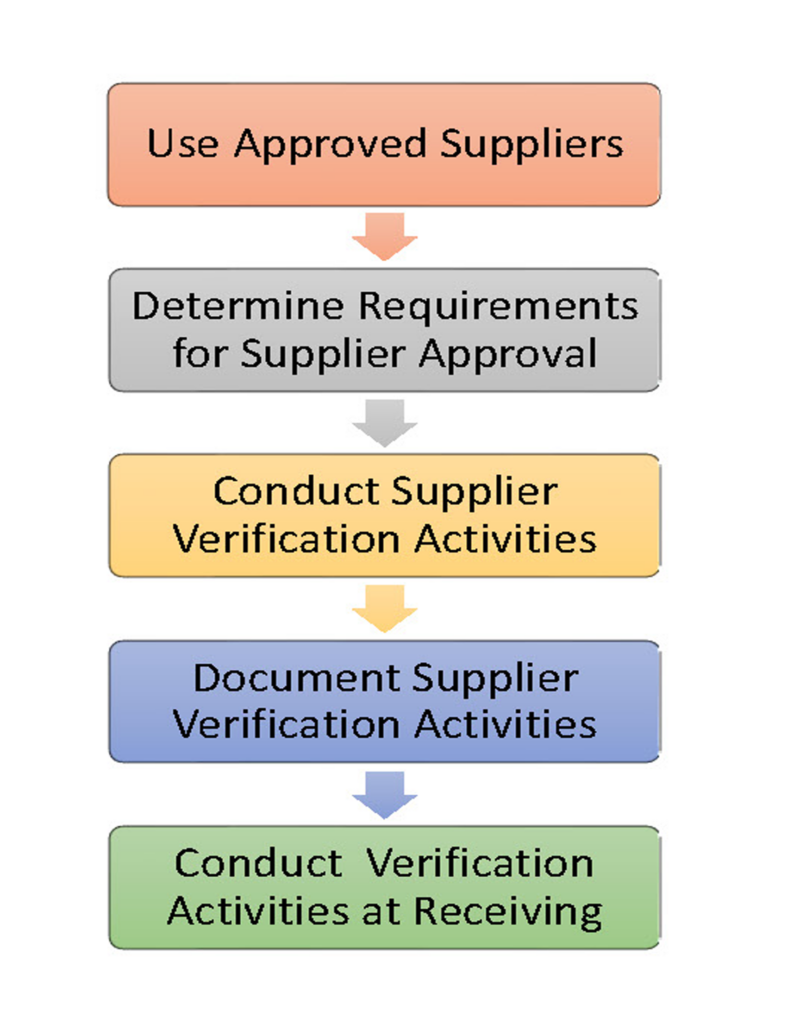
It is important to determine the ability and willingness of a supplier to meet your product specifications. A strong program is based on establishing a formal agreement with your supplier to ensure that they will share in the responsibility for food safety with respect to controlling hazards within their own facility. This may reduce the level of preventive controls needed by you upon receipt of the ingredient.

Your risk is lowest when every ingredient has a written specification detailing microbiological, chemical, and physical requirements as indicated by your hazard assessment and when each lot of ingredient is accompanied by a Certificate of Analysis (COA) reporting the results of appropriate verification testing from a trusted supplier. A robust in-bound receiving program with written procedures for reviewing COAs and documenting shipments with receiving records assures that each shipment meets your specification requirements. Even when other verification activities are in place, testing for hazards controlled by your supplier, at some designated frequency, provides additional evidence that supplier food safety systems are working. Your risk increases when you don’t require a COA for every lot purchased and do not require appropriate verification testing by the supplier or as part of your own receiving program.

Testing upon receipt may seem redundant when the supplier provides a COA. However, independent testing offers not only some assurance of the accuracy of the results reported on the COA, but also assurance that no adulteration of the ingredient has occurred between the time of analysis by the supplier and the time of receipt by the buyer. Verification of the supplier’s testing program as well as your own program should include corroboration that the laboratory performing the analyses is certified to conduct the tests and that methods are accredited and appropriate for testing the ingredients analyzed.

Good management of your suppliers will control microbiological, chemical, physical, Economically Motivated and food fraud hazards. For instance, as part of your Supply Chain Verification program, a review and approval of your supplier’s pathogen and allergen Preventive Control programs will minimize the risk that microbial contaminants and unlabeled allergens will enter your facility. This requires each supplier to have their own written programs. For ingredients you identify as having a particular pathogen concern, close the verification loop with an in-house program that screens statistically representative samples from each lot for the pathogen prior to use – either through a Preshipment Testing program or upon receipt.


The key to an effective Supply Chain Control Program is established policies and procedures and trusted suppliers with whom you are able to partner to prevent product safety issues.

MICROBIOLOGY “101”: FUNDAMENTALS OF MICROBIOLOGY FOR FOOD INDUSTRY PROFESSIONALS

Antonio Alcaraz · November 2, 2023 ·

Virtual Educational Course

April 3, 2024 All day

Understanding the microorganisms that threaten Food Safety and cause food spoilage is fundamental to manufacturing safe and wholesome food products. Microorganisms are everywhere but how can they be controlled in a food production facility?
This course will cover the basics of food safety microbiology and arm you with the information you need to avoid microbial contamination and produce safe food products.
The course features an innovative format, with interactive discussions as well as “virtual lab” demonstrations of microbial detection methods.

Course Topics Include:

• Microbial Ecology: Food safety depends on knowing the conditions that encourage microbial growth and knowing how to keep pathogens out, kill them or keep them from growing.
• Food-borne Pathogens: An understanding of Salmonella, Listeria monocytogenes, Shiga toxin-producing E. coli (STEC) and other pathogens of concern can lead to better strategies for control.
• Indicator organisms: These nonpathogenic organisms are valuable verification tools for hygiene and process controls.
• Spoilage: Yeast and mold are major players in food spoilage. Knowing how to detect, identify and control them can extend shelf life.
• Sampling and Testing: Statistically representative sampling plans and standard methods of analysis are critical to obtaining credible data by which food safety decisions can be made.
• Current Food Safety Issues: Staying informed about foodborne illness outbreaks, recalls and regulations is essential to managing your Food Safety Plan.

Microbiology 101 Team

Book Now

For more information on Microbiology “101” training offered by Deibel Laboratories, please contact Sales at Sales@DeibelLabs.com (847-329-9900).

  • Google Calendar
  • iCalendar
  • Outlook 365
  • Outlook Live

MICROBIOLOGY “101”: FUNDAMENTALS OF MICROBIOLOGY FOR FOOD INDUSTRY PROFESSIONALS

Antonio Alcaraz · November 2, 2023 ·

Virtual Educational Course

February 6, 2024 All day

Understanding the microorganisms that threaten Food Safety and cause food spoilage is fundamental to manufacturing safe and wholesome food products. Microorganisms are everywhere but how can they be controlled in a food production facility?
This course will cover the basics of food safety microbiology and arm you with the information you need to avoid microbial contamination and produce safe food products.
The course features an innovative format, with interactive discussions as well as “virtual lab” demonstrations of microbial detection methods.

Course Topics Include:

• Microbial Ecology: Food safety depends on knowing the conditions that encourage microbial growth and knowing how to keep pathogens out, kill them or keep them from growing.
• Food-borne Pathogens: An understanding of Salmonella, Listeria monocytogenes, Shiga toxin-producing E. coli (STEC) and other pathogens of concern can lead to better strategies for control.
• Indicator organisms: These nonpathogenic organisms are valuable verification tools for hygiene and process controls.
• Spoilage: Yeast and mold are major players in food spoilage. Knowing how to detect, identify and control them can extend shelf life.
• Sampling and Testing: Statistically representative sampling plans and standard methods of analysis are critical to obtaining credible data by which food safety decisions can be made.
• Current Food Safety Issues: Staying informed about foodborne illness outbreaks, recalls and regulations is essential to managing your Food Safety Plan.

Microbiology 101 Team

Book Now

For more information on Microbiology “101” training offered by Deibel Laboratories, please contact Sales at Sales@DeibelLabs.com (847-329-9900).

  • Google Calendar
  • iCalendar
  • Outlook 365
  • Outlook Live

Current Recall a Reminder of Past Incident Involving Frozen Vegetables Contaminated with Listeria monocytogenes

Ryan Maus · September 6, 2023 ·

A new recall of frozen vegetables was published on August 23, 2023, due to the finding of Listeria monocytogenes in sweet cut corn. Recalled products were distributed to major retailers across the U.S. having best by dates as far away as December 2024. Listeria monocytogenes, like many pathogens, will not be eliminated by freezing and will persist in the frozen product. While little information is given in the recall, findings from a 2016 listeriosis outbreak involving frozen vegetables is highlighted in the following.


In 2016, the first multistate outbreak of L. monocytogenes involving frozen vegetables occurred in the U.S. Initially three persons reported illness in 2016, but six more illnesses occurring between 2013 – 2015 were identified using PulseNet traceback data. Two outbreak strains were identified in patients ranging in age from 56 to 91 years and three deaths were reported.


Routine sample of frozen vegetables, and the use of whole genome sequencing (WGS), revealed that eight illnesses were closely related to a strain found in frozen organic white sweet cut corn and one illness to a strain found in frozen organic petite green peas produced by CRF Frozen Foods of Pasco, WA. At the same time, an investigation of the Oregon Potato Company of Pasco, WA found that environmental samples matched the whole genome sequence associated with the eight clinical cases and the CRF frozen organic white sweet cut corn. However, a connection between the companies is unknown because the FDA is prohibited by law from releasing publicly certain information about supply chains, which may constitute confidential commercial information.


A recent publication describes the investigational findings by federal and state regulatory agencies at the two frozen vegetable manufacturers. Observations at the CRF Frozen Foods’ facility indicated that the materials and design of equipment and utensils did not allow proper cleaning and maintenance, and could be potential sources of contamination. An investigation of the facility did not find L. monocytogenes in the environment, but L. innocua was found in zones 1 – 3 which FDA considers evidence of conditions that would be suitable for L. monocytogenes.


Seven L. monocytogenes positive zone 1 swabs, two positive zone 2 swabs, ten positive zone 3 were found in the Oregon Potato Company’s facility. Two of these positives, one zone 1 swab and one zone 3 swab,- matched an outbreak strain also found in CRF’s frozen organic white sweet cut corn. Inspectional observations made include:

  • failure to clean food‐contact surfaces as frequently as necessary to protect against contamination
  • facility construction that did not prevent condensate from contaminating food‐contact surfaces
  • food‐contact surfaces not adequately cleaned and sanitized
  • failure to maintain physical facilities in a sanitary condition
  • facility construction not allowing adequate cleaning of floors and walls

A FDA warning letter was issued and noted the presence of L. monocytogenes in the facility as being indicative of inadequate sanitation efforts to effectively control pathogens in the facility. Although these products are considered not ready‐to‐eat, many consumers may use these products
without proper cooking. Cooking instructions should be clear and validated, and consumers should be informed that consuming undercooked or uncooked frozen vegetables could lead to foodborne illness.

L. monocytogenes Contaminated Pineapple Leads to Recall of Frozen Fruit Products

Ryan Maus · July 18, 2023 ·

A recall of frozen fruit products distributed by major retailers was recently initiated due to contamination of pineapple with Listeria monocytogenes. Little information is provided on where the contamination was detected or how it occurred. Pineapple generally has a low pH below 4.0 that would inhibit Listeria outgrowth. However, pineapple has been involved in outbreaks and pathogens can persist in low pH products and cause illness. The following provides a review of past pineapple incidents and findings.

Pineapple is commonly started in fields by vegetative propagation (i.e. using cuttings from mother plants) producing fruit in 15-22 months. Greater than an inch of water is required each week for growth. The pineapple fruits are harvested by hand and transported to a factory where they are washed, peeled, and cut into pieces prior to final processing into fresh, frozen, or canned products.

While pineapple has not been implicated in outbreaks of L. monocytogenes, it has been associated with outbreaks resulting from enterohemorrhagic E. coli O11:H43 in 1994, Salmonella Weltevreden in 1996, and Salmonella Javiana in 2020. The 1996 outbreak resulted from contaminated industrial water used to wash the fresh produce. A warning letter issued in response to the 2020 outbreak investigation found the following violations:

  • The hazard analysis did not identify and evaluate environmental pathogens to determine whether they are a hazard requiring a preventive control (e.g., sanitation controls).
  • Lapses in GMPs and Sanitation
    • Cleaning did not occur prior to sanitizing. o Monitoring, verification, and record keeping were not implemented.
    • Handwashing SOPs were not implemented correctly
    • Environmental monitoring procedures to verify sanitation controls were not written or implemented.
  • Supply-chain controls were not implemented
    • Reasonably foreseeable hazards such as Salmonella, L. monocytogenes, and pathogenic E. coli were not assessed for the raw agricultural commodities.
    • The washing step was not an adequate preventive control for pathogens if controls are not also in place by the supplier to minimize pathogen contamination.

Listeria monocytogenes is ubiquitous in nature and a natural part of the pineapple growing environment that can transfer to downstream products through environmental contamination during further processing. Once the fruit is manipulated by peeling, cutting, etc. it falls under the Preventive Controls for Human Food Rule and FDA considers L. monocytogenes a pathogen hazard that requires control.

If there is a lapse in control, pathogens such as E. coli O157:H7, Salmonella, and L. monocytogenes have shown the ability to persist in low pH products stored at freezing temperature for long periods of time, potentially resulting in illness if consumed

  • « Go to Previous Page
  • Page 1
  • Page 2
  • Page 3
  • Page 4
  • Go to Next Page »

Footer

CONTACT US

Have a question? Contact our Sales team.

Request Info

Subscribe to our newsletter

Subscribe

“Science you can trust from concept to consumer -since 1967”

We are proud of our integral role in helping to ensure product safety and quality for all our clients.

  • Facebook
  • LinkedIn
  • Twitter

CAREERS

Deibel Laboratories is always seeking energetic individuals to fill positions at our rapidly growing corporation of food and pharma/cosmetic testing laboratories.

VIEW CAREERS

LOCATIONS

California, Idaho, Pennsylvania, Sarasota, Gainesville, Lakeland, Illinois, Minnesota, Missouri, Wisconsin, Kansas, Tennessee, Texas, Canada

SEE LOCATIONS

Copyright © 2026 Deibel Laboratories, All Rights Reserved.
PRIVACY NOTICE · COOKIE POLICY · TERMS AND CONDITIONS