
• Skip to primary navigation
  • Skip to main content
  • Skip to footer
Deibel Laboratories

Deibel Laboratories

Science you can trust from concept to consumer.

  • ABOUT US
    • MEET OUR STAFF
    • ACCREDITATION
    • TERMS AND CONDITIONS
  • SERVICES
    • TESTING SERVICES
      • MICROBIOLOGY
      • CHEMISTRY
      • BACTERIAL / FUNGAL IDENTIFICATION
      • ALLERGEN TESTING
      • NUTRIENT ANALYSES FOR LABELING AND CLAIMS
      • TOXIN TESTING
      • FDA DETENTION SAMPLING
      • PERSONAL CARE & COSMETICS
    • SPECIAL PROJECTS
      • CHALLENGE STUDIES
      • SHELF LIFE STUDIES
      • PROCESS VALIDATION
      • METHOD/MATRIX VALIDATION
    • ADVISORY SERVICES
    • ENVIRONMENTAL MONITORING SERVICES
    • BIOFUELS
    • DEIBEL COLAB 2.0
  • TRAINING AND EDUCATION
    • HACCP TRAINING
    • FSPCA PCQI TRAINING
    • SANITATION OPERATOR TRAINING
    • MICROBIOLOGY 101
    • FSPCA FOREIGN SUPPLIER VERIFICATION PROGRAM (FSVP) TRAINING FOR IMPORTERS OF FOODS FOR HUMAN AND ANIMALS
    • LABELING REQUIREMENTS FOR FOODS AND BEVERAGES
      MARKETED IN THE U.S.
    • GOOD MANUFACTURING PRACTICES
  • CONTACT US
  • Show Search
Hide Search

Deibel Labs

Current Recall a Reminder of Past Incident Involving Frozen Vegetables Contaminated with Listeria monocytogenes

Ryan Maus · September 6, 2023 ·

A new recall of frozen vegetables was published on August 23, 2023, due to the finding of Listeria monocytogenes in sweet cut corn. Recalled products were distributed to major retailers across the U.S. having best by dates as far away as December 2024. Listeria monocytogenes, like many pathogens, will not be eliminated by freezing and will persist in the frozen product. While little information is given in the recall, findings from a 2016 listeriosis outbreak involving frozen vegetables is highlighted in the following.


In 2016, the first multistate outbreak of L. monocytogenes involving frozen vegetables occurred in the U.S. Initially three persons reported illness in 2016, but six more illnesses occurring between 2013 – 2015 were identified using PulseNet traceback data. Two outbreak strains were identified in patients ranging in age from 56 to 91 years and three deaths were reported.


Routine sample of frozen vegetables, and the use of whole genome sequencing (WGS), revealed that eight illnesses were closely related to a strain found in frozen organic white sweet cut corn and one illness to a strain found in frozen organic petite green peas produced by CRF Frozen Foods of Pasco, WA. At the same time, an investigation of the Oregon Potato Company of Pasco, WA found that environmental samples matched the whole genome sequence associated with the eight clinical cases and the CRF frozen organic white sweet cut corn. However, a connection between the companies is unknown because the FDA is prohibited by law from releasing publicly certain information about supply chains, which may constitute confidential commercial information.


A recent publication describes the investigational findings by federal and state regulatory agencies at the two frozen vegetable manufacturers. Observations at the CRF Frozen Foods’ facility indicated that the materials and design of equipment and utensils did not allow proper cleaning and maintenance, and could be potential sources of contamination. An investigation of the facility did not find L. monocytogenes in the environment, but L. innocua was found in zones 1 – 3 which FDA considers evidence of conditions that would be suitable for L. monocytogenes.


Seven L. monocytogenes positive zone 1 swabs, two positive zone 2 swabs, ten positive zone 3 were found in the Oregon Potato Company’s facility. Two of these positives, one zone 1 swab and one zone 3 swab,- matched an outbreak strain also found in CRF’s frozen organic white sweet cut corn. Inspectional observations made include:

  • failure to clean food‐contact surfaces as frequently as necessary to protect against contamination
  • facility construction that did not prevent condensate from contaminating food‐contact surfaces
  • food‐contact surfaces not adequately cleaned and sanitized
  • failure to maintain physical facilities in a sanitary condition
  • facility construction not allowing adequate cleaning of floors and walls

A FDA warning letter was issued and noted the presence of L. monocytogenes in the facility as being indicative of inadequate sanitation efforts to effectively control pathogens in the facility. Although these products are considered not ready‐to‐eat, many consumers may use these products
without proper cooking. Cooking instructions should be clear and validated, and consumers should be informed that consuming undercooked or uncooked frozen vegetables could lead to foodborne illness.
A Recent Soft Serve Ice Cream Outbreak and a Look Back at Past Incidents Involving Pathogen Contamination

Ryan Maus · September 6, 2023 ·

A recent outbreak of listeriosis has been linked to Soft Serve On The Go ice cream cups, resulting in 2 illnesses. An investigation by the Pennsylvania Department of Agriculture detected the presence of Listeria monocytogenes in an unopened sample of ice cream taken from a patient’s home. The product isolate was matched to the clinical L. monocytogenes outbreak strain by whole genome sequencing. Five positive samples of finished product obtained from the production facility by the New York State Department of Agriculture and Markets also matched the outbreak strain.

A recall of products distributed nationally is currently ongoing. However, this is not the first outbreak or recall associated with ice cream and many others have occurred as shown in the tables below.

YearLocationPathogenIllnessesDeathsProducer
2022MultistateL. monocytogenes281Big Olaf Creamery
2014WashingtonL. monocytogenes22Snoqualmie Ice Cream
2010-2015MultistateL. monocytogenes103Blue Bell
2005MultistateSalmonella260Cold Stone Creamery
1994MultistateSalmonellaEstimated 224,0000Schwan’s
Past ice cream outbreaks are shown in the following table.
DatePathogenPathogen SourceProducer
07/13/2022L. monocytogenesEnvironmentBig Olaf Creamery, LLC
06/06/2022SalmonellaPeanut ButterTaharka Brothers Ice Cream
02/12/2022L. monocytogenesEnvironmentThe Royal Ice Cream Company, Inc.
04/27/2021L. monocytogenesNot MentionedVelvet Ice Cream
05/14/2020L. monocytogenesNot MentionedRamar Foods
03/17/2020L. monocytogenesEnvironmentWorking Cow Homemade Ice Cream
Recent ice cream recalls due to pathogen contamination are shown in the following table.

Contamination of ice cream products generally occurs after pasteurization, resulting from sources that include the addition of contaminated inclusions (e.g. fruits, nuts, candy, or bakery pieces) to the finished product, contamination from the production environment, and inadequate sanitation of equipment such as filling heads. Freezing ice cream can prevent pathogen outgrowth, but it will not eliminate pathogen presence. Low levels of pathogens causing illness were identified in the 1994 Schwan’s outbreak (Salmonella 0.004-0.46 MPN/g) and 2015 Blue Bell outbreak (L. monocytogenes 3.9-7.1 MPN/g).

Supplier verification programs are critical to evaluate inclusions and reduce the risk associated with them. Inclusions and flavors must be ready-to-eat and any required Process Preventive Controls must have been applied at the supplier, unless the ice cream manufacturer assumes this responsibility.

Sanitation controls are critical to prevent post pasteurization pathogen contamination of finished ready to-eat ice cream products. This is especially true for L. monocytogenes. Cross contamination with L. monocytogenes from the environment is identified in Blue Bell’s 2015 outbreak and numerous recalls. Ice cream processes can be hard to clean, leaving behind nutrients for microbial growth. Listeria can grow,
form biofilms, and persist in harborage sites such as drains leading to cross contamination. Biofilm formation is a constant problem in ice cream producing facilities and requires proper cleaning and sanitizing procedures for their removal and prevention. The effectiveness of sanitation programs are verified by the results attained from a well-designed environmental monitoring program

IAFP 2023 – Intentional Adulteration (IA) Rule – Update

Ryan Maus · August 3, 2023 ·

The IAFP Food Defense PDG heard a regulatory update on the
Intentional Adulteration (IA) Rule at the annual meeting in Toronto.
Colin Barthel, a policy analyst at FDA (FDECS, OAO, CFSAN) discussed the status of ongoing Food Defense Plan Quick Checks, the Food Defense Plan Builder version 2.0, and what’s next for future full Food Defense Plan inspections.


Food Defense Plan Quick Checks have been occurring during Food Safety (Preventive Controls) inspections conducted by FDA since October 2020. Inspectors assess if a firm is subject to the IA Rule and conduct a visual inspection for presence or absence of a Food Defense Plan. Currently, about 1,000 Quick Checks have been conducted with 70% occurring at domestic facilities and 30% at foreign facilities. Sixty percent of facilities have used the Key Activity Types to conduct their vulnerability assessment while 5% of facilities did not do a vulnerability assessment or have a Food Defense Plan in place.

The Food Defense Plan Builder version 2.0 is a user-friendly tool available to help owners and operators of a food facility to develop a food defense plan that is specific to their facility and meet the requirements of the IA Rule. It has been downloaded 11,489 times. This is more than the estimated 10,000 registered
domestic facilities revealing that many others are also finding this tool useful. The FDA is accepting feedback on the Food Defense Plan Builder version 2.0 for use in updating a future version.


Next steps for FDA involve developing a Food Defense Inspection Team to begin conducting full Food Defense Plan inspections in the next fiscal year. A supervisor for the team was hired and five investigators are to be trained over the next 12 months to conduct full inspections. The FDA identified 25-30 factors that will be used to identify facilities that will be prioritized for full inspection. Currently, all FDA inspections are transitioning to be unannounced. Violations occurring in full Food Defense Plan inspections will be handled as they are for Preventive Controls inspections; they will begin with a FDA form 482 and end with a FDA form 483 being issued.

IA Rule regulatory requirements for covered facilities include the need for a Food Defense Plan. Components of the Plan are a vulnerability assessment; implemented mitigation strategies; documented monitoring activities, corrective actions, and verification procedures. Training and recordkeeping are also requirements. More information is available on FDA’s website. The Food Defense Plan is overseen by a Food Defense Qualified Individual. Training developed to align with regulatory requirements is available from FSPCA.


Resources to assist industry comply with the IA Rule include:

  • IA Rule website
  • Food Defense Training on the FSMA Intentional Adulteration Rule
  • Food Defense Plan Builder version 2.0

IAFP 2023 – Symposium Discusses the Investigation of Ambiguous Outbreaks

Laurie Post · August 2, 2023 ·

A symposium at IAFP 2023 (S64), “Investigating Ambiguous Outbreaks and Adverse Events” sponsored by the Institute for the Advancement of Food and Nutrition Science (IAFNS) Food Microbiology Committee discussed the topic of “ambiguous outbreaks,” those outbreaks of foodborne illness for which definitive sources and/or pathogens targets are not known.

The FDA will issue a public health advisory for outbreak investigations that result in specific, actionable steps for consumers to take to protect themselves. However, some outbreak and adverse event investigations may not conclusively identify a source or reveal any contributing factors. Actionable steps for consumers are not available. FDA maintains a list of outbreak and adverse event (self-reported) investigations managed by their CORE Response teams. Although an investigation may reveal a particular product or product category as a possible source of illness, the FDA will not publicly name a specific product until there is sufficient epidemiological evidence to implicate that product as a cause of illness or an adverse event.

Many investigations do not identify a pathogen or food vehicle responsible for an outbreak or self-reported illnesses in an adverse event despite extensive testing for numerous potential microbial and chemical adulterants. What learnings can be taken from these investigations that could improve resolution and contribute to an improved prevention strategy? This symposium delved into the question. A recording of the symposium will be available from IAFP.

Speakers discussed improved investigational approaches and tools, the use of Root Cause investigation and analysis to uncover factors leading to attribution, improved outbreak communication strategies for reaching consumers and industry, and new areas of research.

Ambiguous outbreaks can be grouped into one or more of the following categories: outbreaks with a known source and unknown agent, a known agent and unknown source, or an unknown agent and unknown source. Dr. Craig Hedberg, University of Minnesota, discussed improved investigational tools to detect and identify a causative agent such as culture independent diagnostic tests (CIDT) and whole genome sequencing. He also reviewed advances in epidemiological and environmental assessments that improve the chances of making connections between an illness and the source when studying outbreaks for which definitive sources and/or pathogens targets are not known.

Dr. Tim Jackson, FDA, reviewed reasons why the root cause of an outbreak is often ambiguous. Investigations into outbreaks are usually retrospective, analytical testing is statistically limited and often inconclusive, and some foods with short shelf lives may not be available for analysis. Additionally, there may be limited tools for analysis of some causative agents. With multi-component or assembled products, processes and supply chains may be complex with a variety of growers/suppliers, manufacturers, retailers, and distributors. Accurate and precise traceability programs are essential to the evaluation of underlying causes. Dr. Jackson discussed the tools available for root cause investigation and analysis and provided examples of how they have been used in the resolution of outbreaks.


Michael Vasser, CDC, examined the impact of reoccurring, emerging, and persisting (REP) strains on ambiguous outbreaks. Some enteric bacterial strains cause acute outbreaks linked to specific sources. Other strains that are closely related by whole genome sequencing, referred to as REP strains, can reoccur and periodically cause acute outbreaks. They can also emerge and increase in frequency or persist and cause illnesses over periods of months or years, despite investigation and prevention efforts. They do not present as typical acute outbreaks. While illnesses caused by REP strains may be associated with a common reservoir or source, the linkage is often inferred but not proven. Mr. Vasser commented that, in fact, most illnesses reported through PulseNet are not linked to a source (90% of isolates do not have an assigned cluster code). REP strains could actually be the cause of a larger fraction of illnesses than
typical outbreaks. Investigation of REP strains will create opportunities to characterize new sources of enteric disease and develop novel prevention approaches.


Mitzi Baum, STOP Foodborne Illness, discussed the critical need for improved communication channels to the public and industry when outbreaks occur. Stop Foodborne Illness is a non-profit public health organization in the United States dedicated to the prevention of illness and death from foodborne pathogens. The organization was founded in 1993 following an E. coli O157:H7 outbreak in California and the Pacific Northwest. While ambiguity in investigations does occur, it is essential that public health officials provide relatable and actionable information to consumers in these circumstances.


IAFP 2023 – Symposium Discusses Establishing Microbiological Performance Standards for Food Safety

Ryan Maus · August 2, 2023 ·

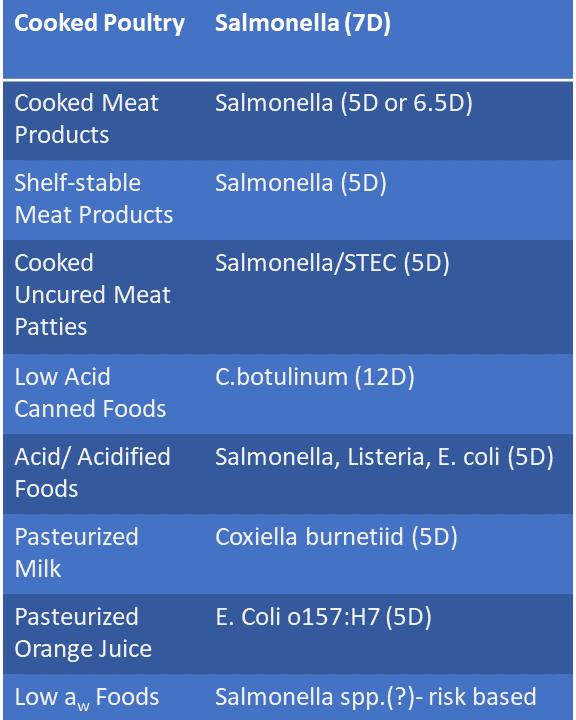
A symposium at IAFP 2023 (S36), “Establishing Microbiological Performance Standards for Food Safety” discussed how industry establishes performance standards for a broad category of food then validates them to meet regulatory requirements. Performance standards are the specific pathogen reduction levels that must be attained during processing to ensure that proper food safety has been achieved. These can be established based on current available scientific literature, scientific studies performed by the company, regulatory requirements, or by using
risk-based pathogen modeling. Validation then demonstrates that the performance standard can be met during routine processing of food.

Stephanie Nguyen, Principal Microbiologist at ConAgra Foods, discussed considerations for designing performance standards for ready-to-eat (RTE) meat and plant proteins, canned foods, and frozen vegetables. For cell cultured meat, FDA regulates the cell collection, banking, growth and differentiation of the cells, then oversight is transitioned to USDA-FSIS at the harvesting stage. These products need to meet USDA pathogen log reductions set forth for meat products from which the original cells originated from (i.e. FSIS Appendix A). Plant based protein products

should attain a minimum 5-log pathogen reduction, the performance standard generally considered acceptable for FDA regulated products in the absence of other readily available performance standards. Performance standards for low acid canned foods are outlined in 21 CFR Part 113 and consist of applying a 12-log reduction in spores while acidified canned food guidance is outlined in 21 CFR part 114. Frozen vegetables are unique in that they are non RTE, therefore validated cooking instructions can provide the consumer necessary requirements to attain a 5-log reduction in pathogen hazards.

Rico Suhalim, Process Authority at PepsiCo, discussed considerations for designing performance standards for juices, sweet and salty snacks, including low-water activity (aw) foods. For acidified juices, HACCP guidance is available from FDA. Thermal processing to meet a minimum 5-log pathogen reduction for acidified foods pH 4.1–4.6 is described by Breidt et al., 2014. For low aw snacks, challenge studies and process validations are generally conducted to meet a 5-log pathogen reduction. It is important to control microbial load with incoming raw ingredients and understand that thermal processes designed for one food matrix may not be appropriate for another (i.e. kibble ≠ meat).

Aaron Uesugi, Principal Scientist at Mondelez, discussed considerations for designing performance standards for bakery and confectionery products. Processors should consider whether they are baking or drying to assess microbial end product risks appropriately. Bakery products can generally be validated for a 5-log pathogen reduction. However low moisture raw ingredients placed on top of the raw dough, such as sesame seeds, should be assessed to make sure they also achieve a 5-log pathogen reduction during the baking process. It is also important to control microbial hazards that may be introduced post process. For example, chocolate can’t be heated to reduce Salmonella risk, roasting the cocoa bean is the only 5- log pathogen kill step, thus sanitation preventive controls verified by an environmental monitoring program are critical to the production of safe product.

A recording of the symposium is available from IAFP and a 2022 publication by one of the presenters provides more information on this topic. Deibel Laboratories has process authorities available to design and conduct challenge studies and validations to meet regulatory safety requirements for your food products.

  • « Go to Previous Page
  • Page 1
  • Page 2
  • Page 3
  • Page 4
  • Page 5
  • Go to Next Page »

Footer

CONTACT US

Have a question? Contact our Sales team.

Request Info

Subscribe to our newsletter

Subscribe

“Science you can trust from concept to consumer -since 1967”

We are proud of our integral role in helping to ensure product safety and quality for all our clients.

  • Facebook
  • LinkedIn
  • Twitter

CAREERS

Deibel Laboratories is always seeking energetic individuals to fill positions at our rapidly growing corporation of food and pharma/cosmetic testing laboratories.

VIEW CAREERS

LOCATIONS

California, Idaho, Pennsylvania, Sarasota, Gainesville, Lakeland, Illinois, Minnesota, Missouri, Wisconsin, Kansas, Tennessee, Texas, Canada

SEE LOCATIONS

Copyright © 2026 Deibel Laboratories, All Rights Reserved.
PRIVACY NOTICE · COOKIE POLICY · TERMS AND CONDITIONS