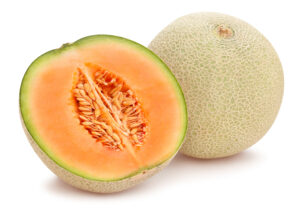
A new outbreak involving imported whole cantaloupe and downstream sliced/cubed cantaloupe containing products contaminated with Salmonella was posted by CDC and FDA officials on November 17, 2023. Currently, 99 individuals in the U.S. and 63 in Canada have reported illness. Initially, whole genome sequencing showed that Salmonella Sundsvall was closely related
genetically to the bacteria collected from those reporting illness. Salmonella Soahanina and Oranienburg are now also identified as outbreak strains detected in the imported product by Canadian officials. Numerous whole and sliced/cubed cantaloupe containing products have been recalled from major retailers across the U.S. and Canada.
Outbreaks involving cantaloupe are not uncommon. Contamination often begins in the field and is then spread to process/packaging facilities where it can become established in the environment. If proper controls are not in place, pathogens can spread to the edible fruit when cut and processed into ready-to eat products. This can spread to further products when cut cantaloupe is used as an ingredient. Investigation reports from three of the outbreaks highlighted in the table below are available from FDA.
| Year | Pathogen | Product | Illnesses | Country |
|---|---|---|---|---|
| 2022 | Salmonella Typhimurium | whole cantaloupe | 87 | USA |
| 2019 | Salmonella Javiana | cut fruit mix containing cantaloupe | 165 | USA |
| 2019 | Salmonella Carrau | cut melon including cantaloupe | 137 | USA |
| 2018 | Salmonella Adelaide | cut melon including cantaloupe | 77 | USA |
| 2012 | Salmonella Typhimurium and Salmonella Newport | whole cantaloupe | 261 | USA |
| 2012 | Listeria monocytogenes | whole cantaloupe | 147 | USA |
| 2011 | Salmonella Panama | whole cantaloupe | 20 | USA |
| 2008 | Salmonella Litchfield | whole cantaloupe | 51 | USA |
The following describes FDA’s investigational findings from their most recent report and provides their recommendations to growers of melons and similar produce. In August 2022, a CDC epidemiological investigation and traceback data identified a multistate cluster of Salmonella Typhimurium illnesses in the upper Midwest indicating melons as a potential source of exposures. The outbreak was traced to cantaloupe and resulted in eighty-seven illnesses and thirty-two hospitalizations across eleven states.
The FDA utilized traceback data to identify a common packinghouse of suspect cantaloupes associated with the outbreak. However, there was no convergence to a single shipment of products. Three farms in southern Indiana that supplied the common packinghouse were identified as potential sources of cantaloupe. Around the growing locations other commodities were grown such as grain, oilseed, and beans; interspersed with various vegetable crops, including melons; and several poultry feeding
operations. Heavy rains had also occurred in the growing region in late July resulting in floods.
Sampling of the packing house, the three farms, and the surrounding lands resulted in numerous findings of Salmonella, but only one of the farms produced an isolate genetically related to the outbreak strain (i.e., having an intermediate level of differences in genomes but not a genetic match). The results suggest that Salmonella presence is a reoccurring issue that may impact the safety of melons grown in this region.
FDA provides the following recommendations/requirements to producers of melons and similar produce.
- Review current conditions and practices to determine whether they are adequate or if additional
prevention measures are warranted. - Understand previous land use to identify and address potential sources of pathogens that may
affect their farming operations. - Assess risks that may be posed by adjacent and nearby land uses, especially as it relates to the
presence of livestock, poultry, and the interface between farmland, and other agricultural areas. - Consider additional tools such as pre-harvest and/or post-harvest sampling and testing of
products to help inform the need for specific prevention measures. - Poultry manure, while valued for its fertilizer value, is a known reservoir for Salmonella
spp. Proper application of a manure that has been treated with a validated and verified process
to reduce pathogens (e.g., composting with time and temperature measurements) can
significantly reduce the potential for the integration of Salmonella or other human pathogens into
soils (as compared to the use of raw manures). - Inspect, maintain, and clean and, when necessary and appropriate, sanitize all food contact
surfaces of equipment and tools used as frequently as necessary to protect against contamination. - When appropriate, use EPA-approved products according to the label for cleaning and sanitizing.
- Inconsistent adherence to or deviation from existing SOPs for cleaning and sanitizing by farms can
affect produce safety. Effective communication on farms about SOPs and any changes to those
SOPs can help ensure that food safety practices are being followed. - Root cause analyses may be useful in identifying for growers how human pathogen sources in the
broader agricultural environment may contribute to contamination. - Improve traceability through increased digitization, interoperability, and standardization of
traceability records which would expedite traceback and help remove contaminated product from
the marketplace more quickly, thereby preventing further illnesses. This is not only important for
growers, but also critical for shippers, manufactures, and retailers as well, to improve overall
traceability throughout the supply chain.